First-Principles Electron-Phonon Coupling for Surface Chemistry and Superconductivity
Electron-phonon coupling from NAO-based DFPT for surface chemistry and superconductivity.
Why it matters
Electron-phonon interactions control vibrational lifetimes, electronic friction, nonadiabatic energy dissipation, and conventional superconductivity. To study these effects in real materials, theory must be accurate but also scalable to surfaces, interfaces, two-dimensional materials, and large low-symmetry unit cells that are inaccessible or inefficient in more restrictive formulations.
What I’ve done
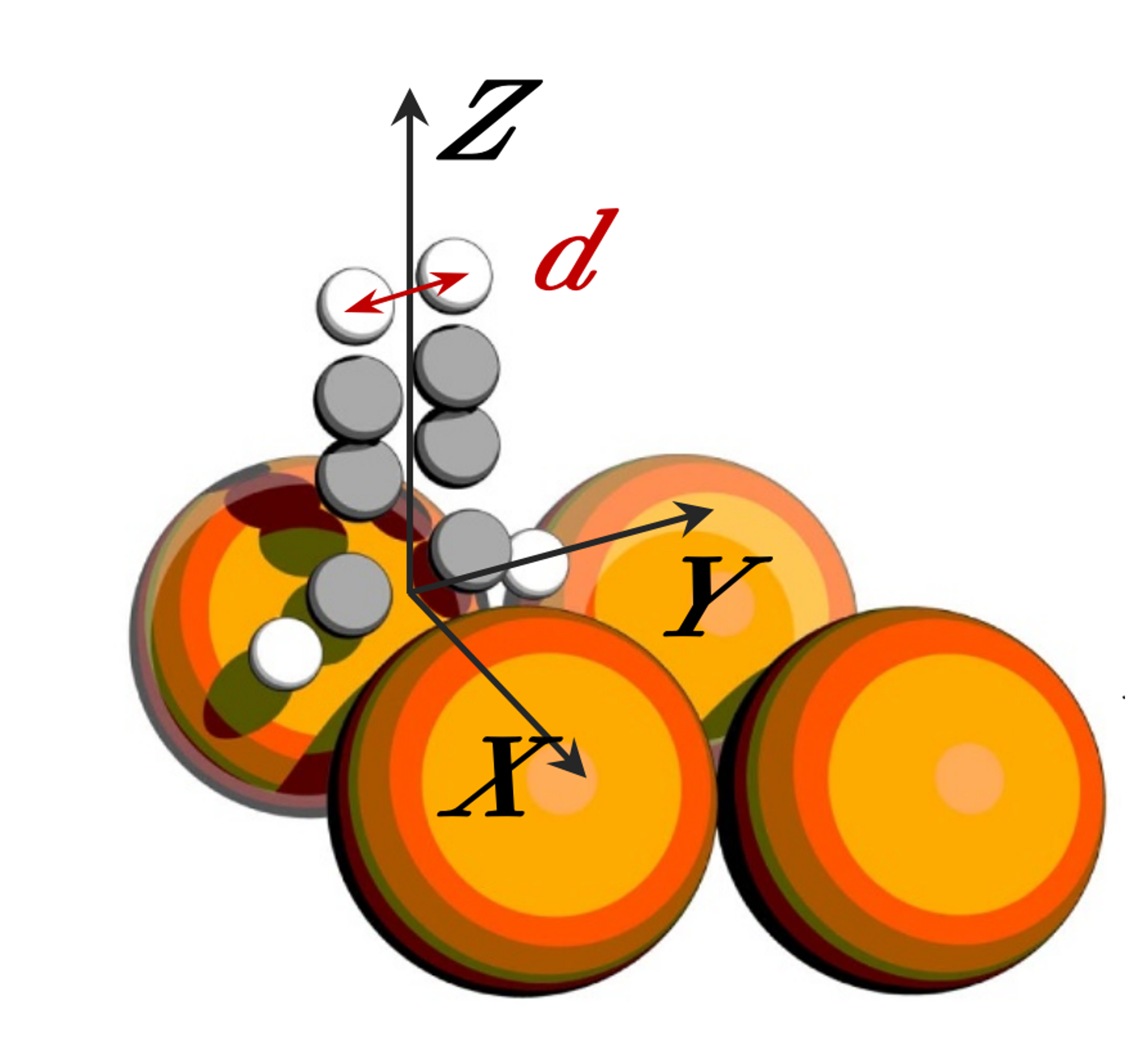
I develop a real-space electron-phonon framework in FHI-aims based on density-functional perturbation theory with numerical atom-centered orbitals. This combination of physical formulation and efficient implementation makes it possible to study larger and more complex systems, including surfaces, low-dimensional materials, and realistic superconducting crystals such as metallic hydrides, within one coherent framework. It provides a route to phonon linewidths, adsorbate friction, Eliashberg functions, and superconducting critical temperatures from first principles.
What I aim to do in the future
I want to push this real-space framework toward predictive electron-phonon materials design across surfaces, two-dimensional systems, complex superconductors, metallic hydrides, and chemically realistic interfaces. A central objective is to combine these methods with AI and ML acceleration so that experimentally relevant observables, including superconducting critical temperatures, can be predicted efficiently for real materials while retaining first-principles rigor.
(Douglas-Gallardo et al., 2021) (Box et al., 2023) (Abbott et al., 2025) (Box et al., 2025)