Nonadiabatic Dynamics and Energy Dissipation at Metal Surfaces

Predictive first-principles models of electronic friction and nonadiabatic energy transfer at metal surfaces.

Why it matters

Understanding how molecules exchange energy with metal surfaces is central to catalysis, corrosion, hot-carrier chemistry, and nanoscale devices. Standard Born-Oppenheimer dynamics often misses the transfer of energy into low-lying electronic excitations, which means it can fail precisely when dissipation controls reactivity and relaxation.

What I’ve done

I have developed and applied electronic-friction-based approaches that resolve how energy loss depends on molecular mode, collision energy, and surface facet. This work has shown when room-temperature scattering benchmarks are insufficient, when nonadiabatic effects become quantitatively important, and how friction models can be made predictive from first principles rather than used phenomenologically.

What I aim to do in the future

In future I aim to extend these ideas toward chemically complex interfaces, realistic catalytic environments, and stronger coupling between theory and experiment. The goal is to build transferable nonadiabatic simulation strategies that can explain measured dynamics and guide the design of interfaces where energy flow is a controllable part of function.

(Box et al., 2020) (Litman et al., 2022) (Litman et al., 2022) (Zhang et al., 2022) (Box et al., 2024) (Stark et al., 2025)
References

2025

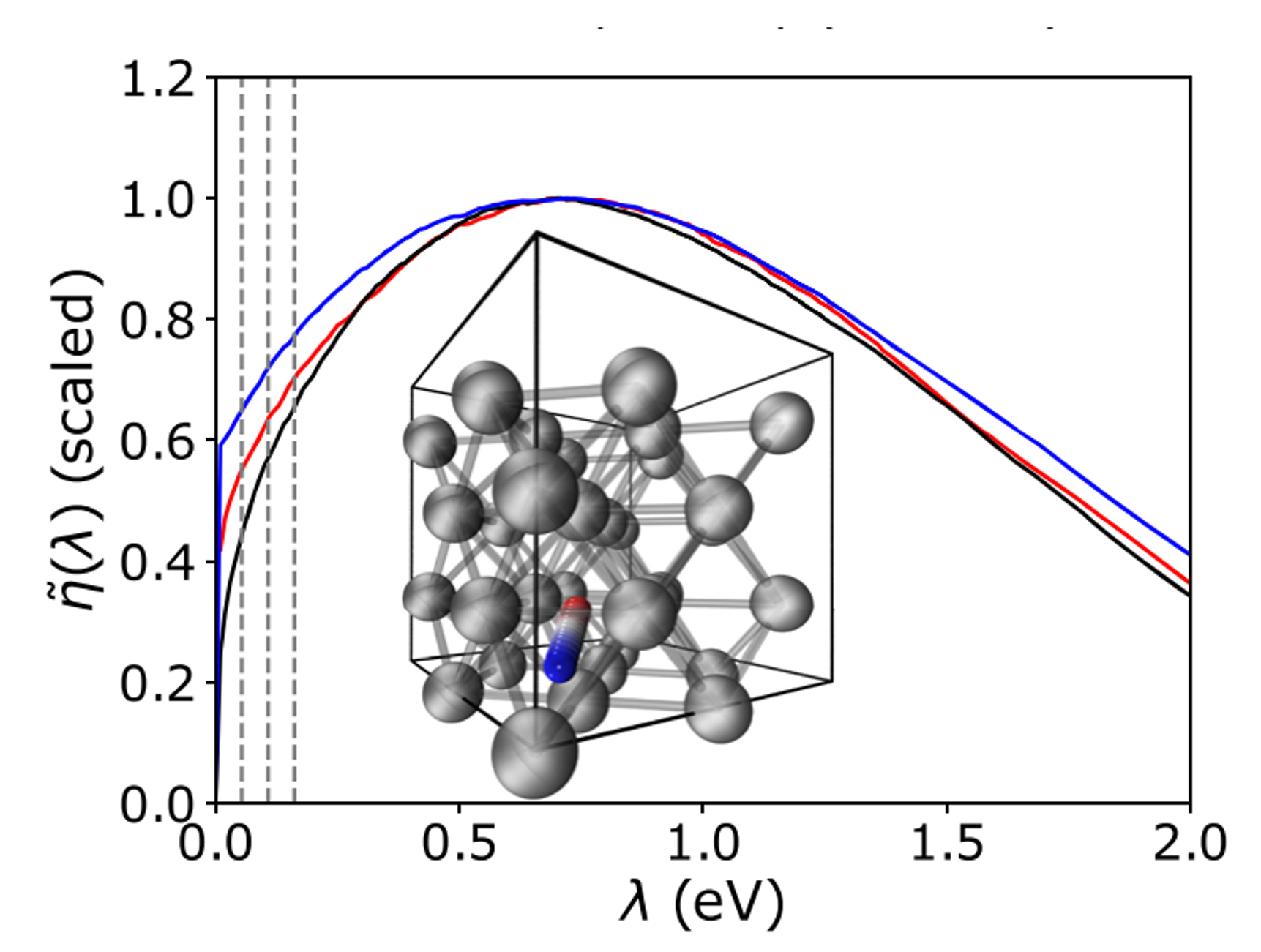
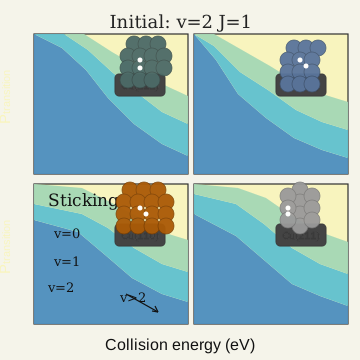
  1. prb_copper_facets.svg
    Nonadiabatic reactive scattering of hydrogen on different surface facets of copper
    Wojciech G Stark, Connor L Box, Matthias Sachs, and 2 more authors
    Physical Review B, 2025

2024

  1. room_temperature.gif
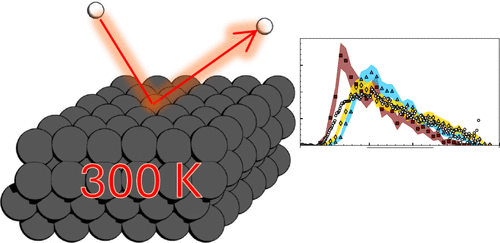
    Room Temperature Hydrogen Atom Scattering Experiments Are Not a Sufficient Benchmark to Validate Electronic Friction Theory
    Connor L Box, Nils Hertl, Wojciech G Stark, and 1 more author
    The Journal of Physical Chemistry Letters, 2024

2022

  1. instanton.png
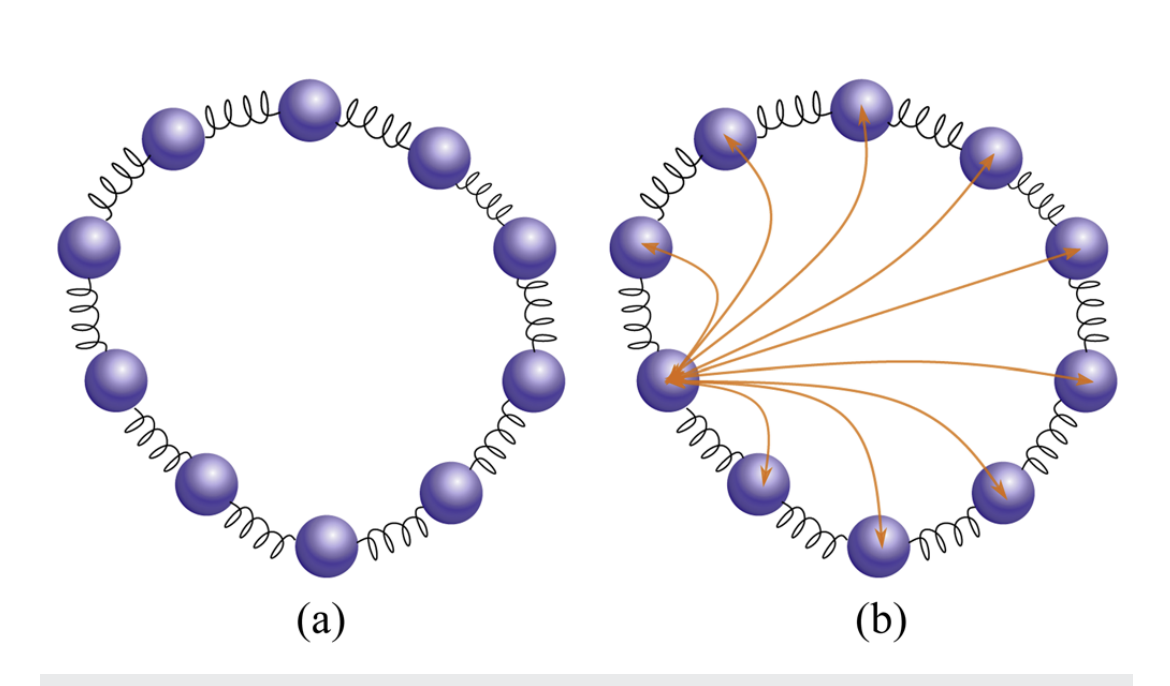
    Dissipative tunneling rates through the incorporation of first-principles electronic friction in instanton rate theory. I. Theory
    Yair Litman, Eszter Sarolta Pós, Connor L Box, and 3 more authors
    The Journal of Chemical Physics, 2022
  2. tunnel.png
    Dissipative Tunneling Rates through the Incorporation of First-Principles Electronic Friction in Instanton Rate Theory II: Benchmarks and Applications
    Yair Litman, Eszter Sarolta Pós, Connor L Box, and 3 more authors
    The Journal of Chemical Physics, 2022
  3. stereo.jpeg
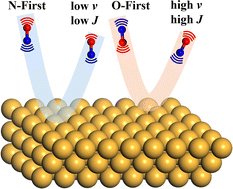
    Stereodynamics of adiabatic and non-adiabatic energy transfer in a molecule surface encounter
    Yaolong Zhang, Connor L Box, Tim Schäfer, and 4 more authors
    Physical Chemistry Chemical Physics, 2022

2020

  1. jacsau.jpeg
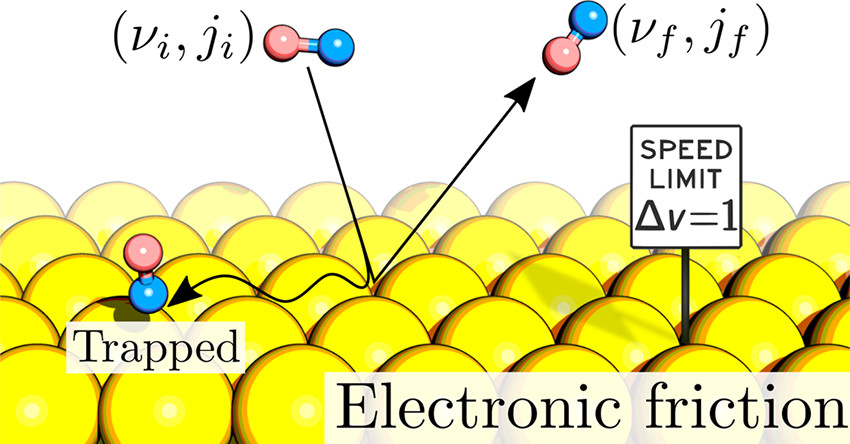
    Determining the effect of hot electron dissipation on molecular scattering experiments at metal surfaces
    Connor L Box, Yaolong Zhang, Rongrong Yin, and 2 more authors
    JACS Au, 2020